

INDIVIDUALIZED CARE FOR AUDITORY PROCESSING DISORDER: TWO CASE STUDIES
APD involves difficulty processing auditory information within the central auditory system, often despite normal peripheral hearing sensitivity on a standard audiogram. A common concern is difficulty understanding speech in background noise, often accompanied by challenges with attention, following verbal directions, retaining spoken information, and communication. These difficulties can affect both children and adults, with day-to-day effects at home, at school, at work, and in social settings.
We would like to share two recent cases from our APD program that illustrate why there is no one-size-fits-all approach to treatment. The most appropriate plan depends on each individual’s listening profile, functional concerns, daily demands, priorities, and access to supports that can be implemented realistically and consistently.
The following pediatric cases highlight two children who followed different treatment paths: one completed formal auditory training, while the other benefited from low-gain amplification and remote microphone technology. Although their treatment approaches differed, both children experienced meaningful improvements in the areas that matter most to families—communication, learning, and participation in everyday life.
Case 1: Building Everyday Listening Skills through Auditory Training
Initial Presentation
John, a 7-year-old boy, was referred for an auditory processing evaluation because of frequent requests for repetition, difficulty understanding speech in background noise, poor memory, and difficulty following multistep verbal directions. His family and school also reported concerns with reading comprehension, spelling, handwriting, mathematics, articulation, and language comprehension. Peripheral hearing sensitivity and middle-ear function were normal bilaterally.
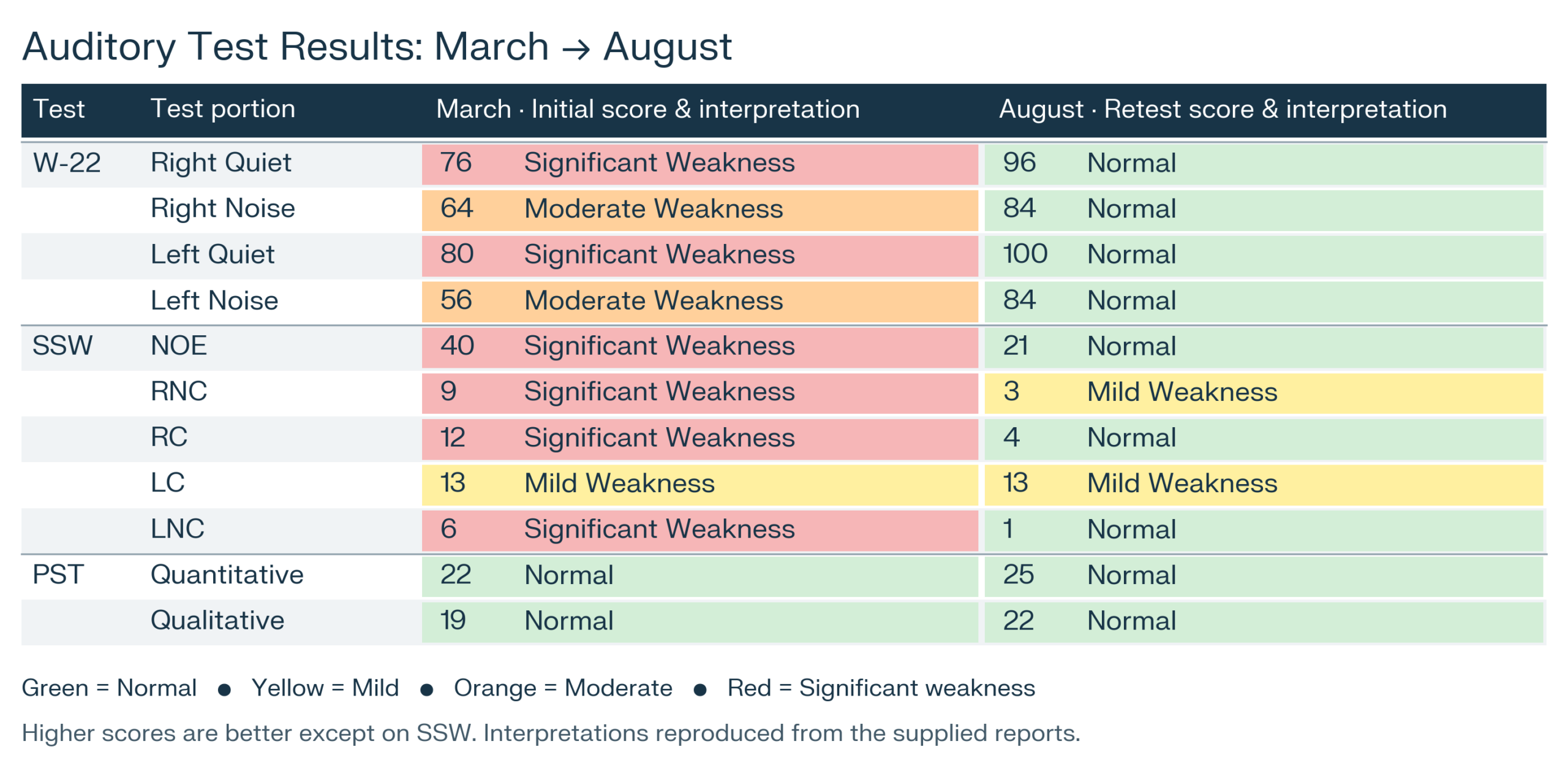
His initial auditory processing evaluation confirmed a diagnosis of APD and identified weaknesses in the following areas:
- Phonemic decoding: efficiently processing individual speech sounds
- Tolerance-fading memory: understanding speech in noise and retaining auditory information
- Binaural integration: combining different auditory information presented to each ear
In daily life, these challenges made it harder for John to keep up with spoken information, particularly when following lengthy directions or listening in busy environments. They also contributed to difficulties with communication and academic tasks at home and at school.
Treatment Approach
John completed 12 weeks of formal Buffalo Model auditory training delivered via telehealth through one of our trusted referral partners. Treatment targeted the listening skills most relevant to his daily difficulties, including understanding speech in background noise, retaining auditory information, decoding speech sounds, and managing competing auditory information.
Functional Outcome
At his post-treatment reevaluation, John’s mother reported meaningful changes in his everyday communication. He was asking for repetition less often, participating more successfully in conversations at home, and maintaining attention more effectively in the presence of background noise. His family and teachers also reported strong academic progress.
Repeat testing showed substantial improvement in the auditory skills identified as areas of concern during his initial evaluation. Most importantly, these measured changes aligned with his family’s observations: listening required less effort, conversations were more successful, and John was better able to manage daily communication demands. These gains were accompanied by meaningful academic improvements.
Clinical Takeaway
For individuals whose listening profiles and family circumstances support structured auditory training, treatment can help strengthen the practical skills that matter most to families: following conversations, listening in noise, managing school or work demands, and participating more confidently at home and with peers.
Case 2: Low-Gain Amplification and Remote Microphone Support for Daily Listening Access
Initial Presentation
Sarah was initially evaluated and diagnosed with APD at an outside clinic using the same central auditory test battery we use in our practice. Her family came to us specifically for treatment.
Her outside evaluation showed normal hearing sensitivity and middle-ear function bilaterally, along with auditory processing weaknesses that affected her understanding of speech in noise, retention of spoken information, and performance on complex listening tasks. Her primary areas of difficulty included phonemic decoding, tolerance-fading memory, and dichotic listening—similar to the concerns described in Case 1.
For Sarah and her family, the concern was not whether she could hear sounds, but how much effort she needed to understand and keep up with spoken information in real-world environments. Classroom noise, group conversations, distance from the speaker, and busy social settings could make listening overwhelming and interfere with her participation.
Treatment Approach
Formal auditory training was recommended. After discussing the available options, however, Sarah’s family felt that low-gain amplification was a better fit for their lifestyle at this stage.
Sarah was fitted with premium-level Phonak hearing aids that use AI-driven, automatic signal management to support listening in background noise. She also uses a remote microphone system connected to her hearing aids in the classroom, with reported success.
Functional Outcome
Sarah’s mother has reported meaningful improvements in Sarah’s ability to follow and understand spoken information. Sarah appears less overwhelmed by listening demands and better able to participate in everyday activities at home, at school, and in social settings.
Her family has observed more successful interactions with peers in noisy environments that previously would have felt overwhelming, along with improved day-to-day functioning at home and at school. The combination of low-gain amplification, classroom remote microphone support, and individualized care has helped reduce her listening burden while meeting her family’s current needs.
To read Sarah’s family’s account in their own words, see their testimonial, Our Experience with Auditory Processing Difficulties.
Clinical Takeaway
Auditory training remains an important option for many individuals with APD, but it is not the only meaningful intervention. For some individuals, low-gain amplification can provide practical support by reducing listening effort and improving access to speech at school, at home, and in social settings.
Our Patient Care Philosophy
APD management should be individualized, functional, and collaborative. Rather than focusing solely on test scores, we consider how listening challenges affect a child’s communication, learning, confidence, relationships, and participation in daily life.
These two cases illustrate that philosophy: one child thrived with a structured auditory training program, while another is flourishing with amplification and classroom technology tailored to her family’s routine. Both approaches led to the outcomes that matter most to these families—meaningful improvements in everyday listening and learning.
If you are seeing a child or adult with normal hearing test results but persistent listening difficulties—such as trouble understanding speech in noise, frequent requests for repetition, or unexplained academic or attention concerns—we would welcome the opportunity to evaluate them and develop an individualized intervention plan that fits their needs and daily life.
Note: Individual’s names have been changed to protect privacy. Parents or legal guardians have provided consent for their child’s results and information to be included in this shared case study.